Katie Elizabeth Stubblefield

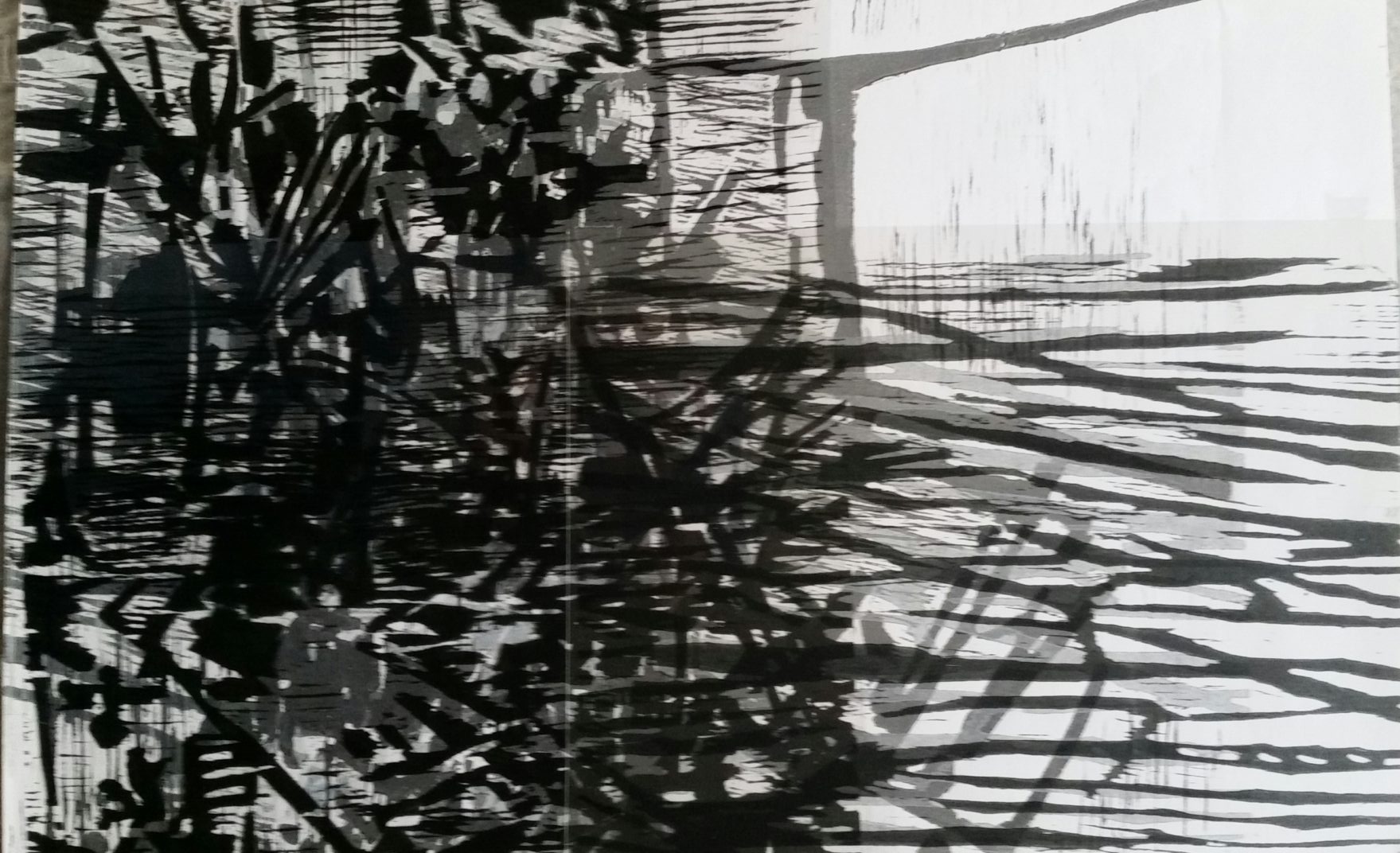
Katie Stubblefield creates wood cut prints, oil paintings, sculptures, large-scale drawings, and site-specific installations that explore order, chaos, and entropy. Growing up in Tennessee’s old-growth forests before relocating to Southern California, she developed a fascination with tracking wind through tree canopies—an experience that continues to inform her investigation of nature’s overwhelming power.

Her imagery is informed by site visits, forensic photography, first-hand accounts, and evidence of changed environments caused by super-sized storm patterns and climate change. Working with both traditional materials and repurposed substrates like discarded plexiglass and sailcloth, Stubblefield transforms environmental debris into layered studies of ecological disruption and renewal.

Recent works examine dust devils and updrafts as real-time indicators of global warming, overlaying imagery from flood zones and earthquake fault lines with local infrastructure. Her sculptural installations incorporate fishing nets, concrete, rebar, and architectural debris, freezing moments of environmental onslaught while questioning what emerges in devastated landscapes.

Stubblefield holds an MFA from California State University, Long Beach, and teaches at Coastline College. She has received fellowships from the Long Beach Arts Council and a 2025 Kipaipai Artist Development Fellowship. Her works are exhibited nationally and held on consignment at galleries including K. Imperial Fine Arts, SCAPE, and SALT.
Genres

, , , , ,

Contact Information

Katie Stubblefield
(562) 477-8038
kestubblefield@verizon.net

Artist Links

Website

Facebook

Instagram

Artist Work

Comeuppance (2020)
I make works of abjection, optimism, and entropy- systems burning, collapsing, resting, and reintegrating. Erratic weather’s aftermath fuels my work. Comeuppance, a chandeliered sculpture, is a frozen reflection of the moment of the onslaught of the storm and the birth of debris-of uprooting, tangling, air-born twisting, dying and recreating.

Collateral Damages (2024)
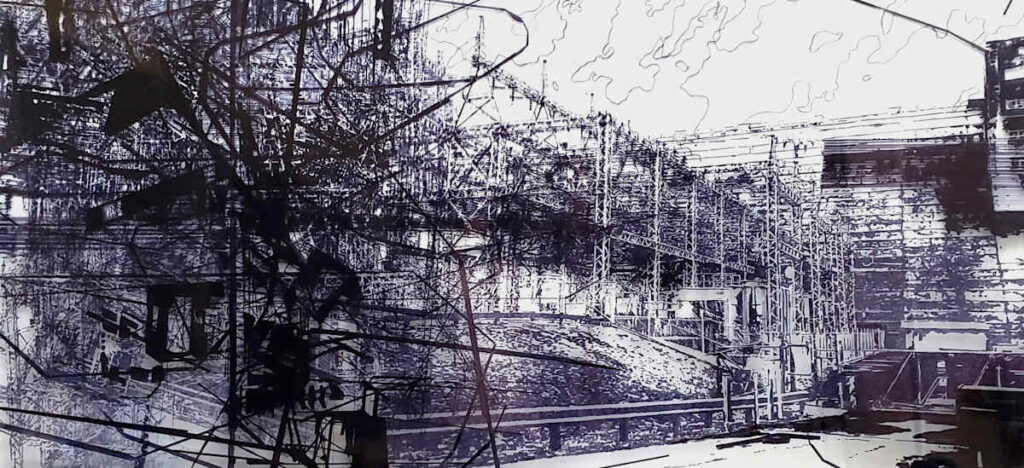
These drawings, done on discarded plexiglass with Sharpie markers, are the result of a forensic study of past flood and fire zones, earthquake fault lines, global warming projections, and conspiracy theories. Mark-making from these maps intersect with imagery of local current, abandoned or reclaimed infrastructure. Initially these works started simply as plein air studies, utilizing the scratched-up plexiglass as a view finder and sighting tool. As I worked, I started overlaying with the landscaped and industrial imagery. Over time this imagery has evolved, building layers of drawing on both the front and back of the plexiglass, building density and shadow into the final works.

Cat in the Box (2025)
These drawings, done on discarded plexiglass with Sharpie markers, are the result of a forensic study of past flood and fire zones, earthquake fault lines, global warming projections, and conspiracy theories. Mark-making from these maps intersect with imagery of local current, abandoned or reclaimed infrastructure. Initially these works started simply as plein air studies, utilizing the scratched-up plexiglass as a view finder and sighting tool. As I worked, I started overlaying with the landscaped and industrial imagery. Over time this imagery has evolved, building layers of drawing on both the front and back of the plexiglass, building density and shadow into the final works.

Thousands are Sailing (2025)
60"X288", sailcloth, D rings, nautical ropes, acrylic paint and sharpie, These drawings, done on discarded plexiglass with Sharpie markers, are the result of a forensic study of past flood and fire zones, earthquake fault lines, global warming projections, and conspiracy theories. Mark-making from these maps intersect with imagery of local current, abandoned or reclaimed infrastructure. Initially these works started simply as plein air studies, utilizing the scratched-up plexiglass as a view finder and sighting tool. As I worked, I started overlaying with the landscaped and industrial imagery. Over time this imagery has evolved, building layers of drawing on both the front and back of the plexiglass, building density and shadow into the final works.

Downfall (2025)
48"X96", sharpie on plexi, These drawings, done on discarded plexiglass with Sharpie markers, are the result of a forensic study of past flood and fire zones, earthquake fault lines, global warming projections, and conspiracy theories. Mark-making from these maps intersect with imagery of local current, abandoned or reclaimed infrastructure. Initially these works started simply as plein air studies, utilizing the scratched-up plexiglass as a view finder and sighting tool. As I worked, I started overlaying with the landscaped and industrial imagery. Over time this imagery has evolved, building layers of drawing on both the front and back of the plexiglass, building density and shadow into the final works.

Upshot (with chair) (2024)
48"X96", sharpie on plexi, These drawings, done on discarded plexiglass with Sharpie markers, are the result of a forensic study of past flood and fire zones, earthquake fault lines, global warming projections, and conspiracy theories. Mark-making from these maps intersect with imagery of local current, abandoned or reclaimed infrastructure. Initially these works started simply as plein air studies, utilizing the scratched-up plexiglass as a view finder and sighting tool. As I worked, I started overlaying with the landscaped and industrial imagery. Over time this imagery has evolved, building layers of drawing on both the front and back of the plexiglass, building density and shadow into the final works.